Can Kidney Stones Go Away Naturally? When to Seek Medical Care

Introduction
Kidney stones are hard, pebble-like deposits that form when certain minerals and salts become concentrated in the urine. They can vary considerably in size, and their location within the urinary tract also affects whether they can pass naturally.
One of the most common questions people have after being diagnosed with a kidney stone is: Can kidney stones go away naturally?
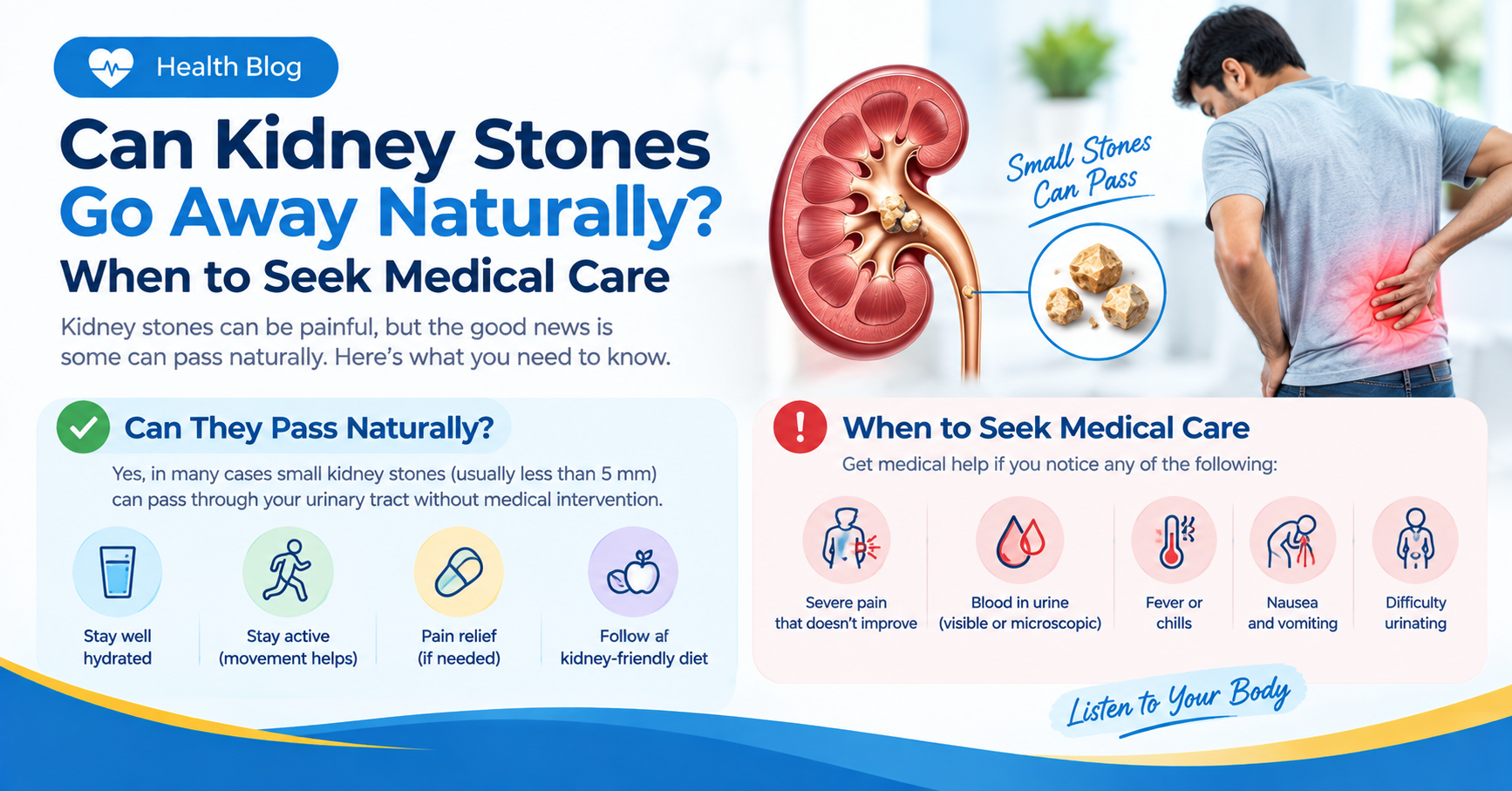
The answer is sometimes yes. Small kidney stones may pass through the urinary tract without a procedure. However, not every stone can pass safely on its own. Larger stones may become stuck, block the flow of urine, cause severe pain, or contribute to infection and other complications.
Therefore, the decision to simply wait for a stone to pass should depend on factors such as its size, location, symptoms, and your overall health.
Can Kidney Stones Pass Naturally?
Yes, some small kidney stones can pass naturally through the urinary tract. When a stone is small enough, it may travel from the kidney through the ureter and eventually leave the body through urine.
Some small stones may cause little or no discomfort. Others can cause significant pain while moving through the urinary tract. The time required for a stone to pass can vary from person to person.
A healthcare professional may recommend monitoring a small stone and managing symptoms while waiting for it to pass. Drinking enough fluids may be advised if it is appropriate for your health, and pain medication may be prescribed when necessary.
However, "natural passage" does not mean that every kidney stone should be ignored. Medical evaluation can help determine whether waiting is appropriate or whether treatment is needed.
What Determines Whether a Kidney Stone Can Pass?
The size and location of the stone are important factors when doctors decide how to manage kidney stones.
A small stone is generally more likely to pass through the urinary tract than a larger stone. A larger stone may become stuck and block urine flow. The location of the stone can also affect its ability to move through the urinary tract.
Doctors may use imaging tests to determine the stone's size and location and assess whether it is causing an obstruction or other problems. Treatment decisions are then made based on these findings and the patient's symptoms.
This is why simply knowing that you have a "kidney stone" is not enough to determine whether it will pass naturally.
What Does Passing a Kidney Stone Feel Like?
Some people may pass a small kidney stone with very few symptoms. Others may experience intense pain as the stone moves through the urinary tract.
Kidney stone symptoms can include sharp pain in the back, side, lower abdomen, or groin. The pain may come and go in waves and can sometimes be accompanied by nausea or vomiting. Blood in the urine, pain while urinating, frequent urination, or difficulty passing urine may also occur.
The location of the pain can change as the stone moves. For this reason, sudden or severe pain in the side or back should not automatically be assumed to be a simple muscular problem.
How Long Does It Take for a Kidney Stone to Pass?
There is no single timeframe that applies to every kidney stone.
Some small stones may pass relatively quickly, while others may take longer. The time can depend on the stone's size and location as well as the individual's urinary tract and other health factors.
If a stone does not pass, continues to cause significant symptoms, or blocks urine flow, waiting indefinitely is not appropriate. A doctor can monitor the stone and decide whether further treatment is necessary.
Can Drinking Water Help a Kidney Stone Pass?
Adequate fluid intake is an important part of kidney stone management and prevention. Water can help maintain urine flow and may help a small stone move through the urinary tract when passage is possible.
However, drinking excessive amounts of water does not guarantee that a large or obstructing stone will pass. If a person has a blockage, severe pain, vomiting, or another complication, medical treatment may be necessary.
People with certain medical conditions, including some kidney or heart conditions, may have specific fluid restrictions. Therefore, the appropriate amount of fluid should be discussed with a healthcare professional when necessary.
Signs That a Kidney Stone May Be Passing
As a stone moves through the urinary tract, symptoms can change. Pain may shift from the back or side toward the lower abdomen or groin. Some people may experience an increased urge to urinate or discomfort while urinating.
Blood in the urine can also occur when a kidney stone irritates the urinary tract. Urine may appear pink, red, or brown.
These symptoms can be associated with kidney stones, but they are not exclusive to stones. A proper medical evaluation is important when symptoms are severe, persistent, or unusual.
When Can a Kidney Stone Become a Problem?
A kidney stone can become a medical concern when it gets stuck and blocks the flow of urine. A blocked stone may cause severe pain and can increase the risk of urinary infection and other complications.
According to the NIDDK, larger stones or stones that block the urinary tract or cause significant pain may require urgent treatment.
A stone that remains untreated can also be associated with complications such as urinary tract infections and, in some situations, loss of kidney function.
This is why severe symptoms should not be managed at home without medical advice.
When Should You Seek Medical Care for Kidney Stones?
You should consult a doctor if you have symptoms that suggest a kidney stone, particularly if the pain is severe, recurring, or does not improve.
Medical attention becomes especially important if you experience:
- Severe pain in the back, side, abdomen, or groin
- Blood in the urine
- Fever or chills
- Nausea or repeated vomiting
- Difficulty passing urine or inability to urinate
- Cloudy or foul-smelling urine
- Symptoms that are getting worse
Fever and chills alongside urinary symptoms can be particularly concerning because they may indicate an infection. A blocked urinary tract combined with infection can require urgent medical treatment.
How Are Kidney Stones Diagnosed?
When a kidney stone is suspected, a doctor may begin with your medical history and physical examination. Information about the location and intensity of pain, urinary symptoms, previous kidney stones, and other medical conditions can help guide the evaluation.
Urine and blood tests may be used to look for signs of infection, blood, or other abnormalities. Imaging tests can help identify the stone, determine its size and location, and check whether it is blocking urine flow. Depending on the situation, doctors may use ultrasound, X-rays, CT scans, or other appropriate imaging methods.
Knowing the stone's size and location helps the doctor decide whether observation is reasonable or whether an active treatment is needed.
What Happens If the Kidney Stone Does Not Pass Naturally?
If a kidney stone does not pass on its own, doctors have several treatment options.
For some stones, shock wave lithotripsy may be used to break the stone into smaller pieces so they can pass more easily through the urinary tract.
Another option is ureteroscopy, in which a specialist uses a thin instrument to locate the stone and remove it or break it into smaller pieces.
For larger or more difficult stones, percutaneous nephrolithotomy may be considered. This procedure allows the doctor to access and remove the stone through a small opening in the back.
The appropriate treatment depends on the stone's size, location, composition, symptoms, and whether it is causing obstruction or other complications.
Should You Wait for a Kidney Stone to Pass on Its Own?
Waiting may be appropriate for some small stones when a healthcare professional has assessed the situation and determined that natural passage is reasonably safe.
However, waiting without medical evaluation can be risky when the stone is large, symptoms are severe, urine flow is blocked, or infection is suspected.
If you have already been diagnosed with a kidney stone, follow the treatment and follow-up plan recommended by your doctor. If symptoms suddenly become worse, seek medical attention rather than continuing to wait.
Can Kidney Stones Be Prevented?
Having one kidney stone can increase the likelihood of developing another. Prevention usually involves understanding why the stone formed and making appropriate changes based on its type.
Drinking enough fluids, particularly water, is one of the most important general measures for reducing the risk of many kidney stones. Depending on the type of stone, a healthcare professional may also recommend changes to sodium, animal protein, calcium, or oxalate intake.
There is no single diet that is suitable for everyone with kidney stones. Prevention should ideally be based on the type of stone and the individual's health and dietary needs.
What Should You Do After Passing a Kidney Stone?
If you pass a kidney stone, your doctor may recommend collecting it for laboratory analysis. Knowing the type of stone can help identify factors that contributed to its formation and may guide future prevention.
In some cases, your healthcare professional may also recommend urine or blood tests to understand your risk of developing additional stones.
Preventing another stone is important because kidney stone disease can recur.
Kidney Stone Treatment in Jaipur
If you are experiencing symptoms of kidney stones, timely medical evaluation can help determine whether the stone can pass naturally or requires treatment.
For people searching for kidney stone treatment in Jaipur, kidney care in Jaipur, or a kidney stone hospital in Jaipur, it is important to choose a healthcare facility where appropriate diagnostic evaluation and medical treatment are available.
At Pawan Hospital, Jaipur, patients can receive medical consultation and diagnostic evaluation according to their symptoms and healthcare needs. The hospital is located on Amer Road, Jaipur, and provides outpatient, diagnostic, inpatient, operative, and emergency services.
Pawan Hospital Jaipur
Pawan Hospital is a multispecialty hospital located at 27, Govindpuri East, New Ramgarh Mode, Amer Road, Jaipur, Rajasthan 302002.
Patients experiencing kidney stone symptoms can seek medical evaluation to understand the size and location of the stone and whether observation or treatment may be appropriate.
Pawan Hospital also provides 24-hour emergency services, which can be important when symptoms such as severe pain, vomiting, fever, chills, or difficulty passing urine require prompt attention.
For patients looking for a hospital in Amer Road Jaipur or medical care in Jaipur, timely evaluation can help prevent complications and ensure that kidney stone treatment is based on the patient's individual condition.
Conclusion
So, can kidney stones go away naturally? Yes, some small kidney stones can pass through the urinary tract without a procedure. However, the ability of a stone to pass depends on factors such as its size, location, and whether it is causing obstruction or significant symptoms.
Drinking an appropriate amount of water may support stone passage when advised by a healthcare professional, but it should not be considered a guaranteed solution for every kidney stone.
Severe pain, fever, chills, repeated vomiting, difficulty passing urine, blood in the urine, or worsening symptoms are reasons to seek medical attention promptly.
If you suspect that you have a kidney stone, getting the condition properly evaluated can help determine whether it is safe to wait or whether treatment is required.
Author